
Model-Data Fit Evaluation
Source:vignettes/articles/model-fit-evaluation.Rmd
model-fit-evaluation.RmdOverview
After item calibration, it is essential to verify that the chosen IRT model adequately describes the observed item response data. A misfitting item can lead to biased ability and item parameter estimates, which in turn jeopardize the validity of test score interpretations and downstream applications such as equating and CAT (Ames & Penfield, 2015).
irtQ provides two complementary sets of item-level fit tools:
| Function | Statistics | Conditioning variable |
|---|---|---|
irtfit() |
, , infit, outfit | Estimated (ability bins) |
sx2_fit() |
-(Kang & Chen, 2008; Orlando & Thissen, 2000, 2003) | Observed summed score |
Both functions accept an est_irt object (produced by
est_irt()), an est_item object (produced by
est_item()), or a plain item metadata data frame as their
first argument x, and both support mixed-format tests
containing dichotomous and polytomous items.
Setup: Calibrated Data for All Examples
We define two test forms (a binary-only test and a mixed-format test) and calibrate each so we have item parameters and ability estimates to pass to the fit functions throughout this vignette.
Binary test (20 items, 3PLM)
# True item parameters
meta_bin <- shape_df(
  par.drm = list(
    a = c(1.0, 1.2, 0.8, 1.4, 0.9, 1.1, 1.3, 0.7, 1.0, 1.2,
          0.9, 1.1, 1.4, 0.85, 1.0, 1.2, 0.8, 1.1, 1.3, 0.9),
    b = c(-2.0, -1.5, -1.0, -0.6, -0.2, 0.0, 0.4, 0.8, 1.1, 1.5,
          -1.3, -0.4,  0.5,  1.0,  1.8, -0.8, 0.2, 0.7, -1.1, 1.3),
    g = rep(0.15, 20)
  ),
  item.id = paste0("ITEM", 1:20),
  cats    = 2,
  model   = "3PLM"
)

# Simulate 1000 examinees from N(0, 1)
theta_bin <- rnorm(1000, mean = 0, sd = 1)
resp_bin  <- simdat(x = meta_bin, theta = theta_bin, D = 1.702)
# Calibrate item parameters
mod_bin <- est_irt(
  data       = resp_bin,
  D          = 1.702,
  model      = "3PLM",
  cats       = 2,
  item.id    = paste0("ITEM", 1:20),
  use.gprior = TRUE,
  gprior     = list(dist = "beta", params = c(4, 16)),
  EmpHist    = FALSE,
  verbose    = FALSE
)
meta_cal_bin <- mod_bin$par.est

# ML ability estimates (irtfit() needs ability estimates; EAP estimates also work)
score_bin <- est_score(
  x      = meta_cal_bin,
  data   = resp_bin,
  D      = 1.702,
  method = "ML",
  range  = c(-5, 5)
)
Mixed-format test (15 items 3PLM + 5 items GRM, 4 categories)
meta_mix <- shape_df(
  par.drm = list(
    a = c(1.0, 1.2, 0.9, 1.1, 0.8, 1.3, 1.0, 0.9, 1.1, 1.2,
          0.85, 1.1, 1.3, 0.9, 1.0),
    b = c(-1.5, -1.0, -0.5, -0.2, 0.2, 0.5, 0.8, 1.1, 1.4, -1.2,
          -0.4,  0.1,  0.6,  1.0, -0.8),
    g = rep(0.15, 15)
  ),
  par.prm = list(
    a = c(1.5, 1.2, 1.0, 1.3, 0.9),
    d = list(
      c(-1.5, -0.3,  0.9),
      c(-1.2,  0.0,  1.1),
      c(-0.9,  0.4,  1.4),
      c(-1.1, -0.1,  1.0),
      c(-1.3,  0.3,  1.2)
    )
  ),
  item.id = c(paste0("DRM", 1:15), paste0("GRM", 1:5)),
  cats    = c(rep(2, 15), rep(4, 5)),
  model   = c(rep("3PLM", 15), rep("GRM", 5))
)

theta_mix <- rnorm(1000, mean = 0, sd = 1)
resp_mix  <- simdat(x = meta_mix, theta = theta_mix, D = 1.702)
mod_mix <- est_irt(
  data       = resp_mix,
  D          = 1.702,
  model      = c(rep("3PLM", 15), rep("GRM", 5)),
  cats       = c(rep(2, 15), rep(4, 5)),
  item.id    = c(paste0("DRM", 1:15), paste0("GRM", 1:5)),
  use.gprior = TRUE,
  gprior     = list(dist = "beta", params = c(4, 16)),
  EmpHist    = FALSE,
  verbose    = FALSE
)
meta_cal_mix <- mod_mix$par.est

# EAP ability estimates
score_mix <- est_score(
  x          = meta_cal_mix,
  data       = resp_mix,
  D          = 1.702,
  method     = "EAP",
  norm.prior = c(0, 1),
  nquad      = 41
)
Part 1: Traditional Fit Statistics with irtfit()
How irtfit() Works
irtfit() computes four classical item-level fit
statistics by grouping examinees into ability bins and comparing the
observed response frequencies in each bin with the
expected frequencies predicted by the calibrated item response
function (IRF).
All statistics are built on the same underlying individual-level residual:
where is examinee ’s scored response to item and is the IRF-predicted probability of that response at the examinee’s estimated ability (Ames & Penfield, 2015).
The four statistics differ in how they aggregate these residuals:
and : Group-based statistics
Note. The formulas below are presented for dichotomous items (scored 0/1) for clarity. The same group-based framework extends to polytomous items by replacing the binary response with category-specific observed and expected frequencies, but the dichotomous form is the standard reference in the literature (Ames & Penfield, 2015).
Examinees are first sorted into ability bins. Within each bin :
where is the number of examinees in bin , is the observed number of correct responses, is the observed proportion correct, and is the model-predicted expected proportion correct in that bin.
- follows Bock (1960) and Yen (1981). Its degrees of freedom equal the number of ability bins minus the number of item parameters, (Ames & Penfield, 2015).
- follows McKinley & Mills (1985). Its degrees of freedom equal the number of ability bins, (Ames & Penfield, 2015).
Extension to polytomous items: For items with response categories, the degrees of freedom are extended to account for the multiple categories. The statistic has , and the statistic has , where is the final number of ability bins after any necessary cell collapsing.
Key difference between and df: For the statistic, the number of item parameters of the item’s model (including parameters fixed in the calibration) is subtracted from the df (e.g., for a 3PLM item with bins left after any cell collapsing, ). For , no such subtraction is made (). Here is the number of groups that remain after cell collapsing, so it can be smaller than
n.widthand differs across items. uses more degrees of freedom and tends to be more conservative.
Infit and Outfit: Individual-level statistics
Both infit and outfit treat each examinee as a separate bin (i.e., ) (Ames & Penfield, 2015; Wright & Panchapakesan, 1969):
The key difference is weighting:
- Outfit gives equal weight to each examinee. It is therefore more sensitive to unexpected responses at extreme ability levels (far from item difficulty), where is small and a single aberrant response inflates the statistic dramatically.
- Infit weights each residual by , the response variance at that ability level (for the 3PLM this is not the item information). This down-weights extreme responses and makes infit more sensitive to misfit near the item difficulty, where most measurement information resides. For this reason, infit is generally preferred in practice.
Caution for non-Rasch models. Infit and outfit were developed in the Rasch measurement tradition (Wright & Panchapakesan, 1969) and their expected distributions under non-Rasch models (2PLM, 3PLM, GRM, GPCM) are less well understood. Use them as supplementary diagnostics alongside / when fitting these models (Ames & Penfield, 2015).
Ability Grouping: group.method, n.width,
and loc.theta
Because and require binning examinees by ability, the grouping choices materially affect the statistics:
| Argument | Option | Description |
|---|---|---|
group.method |
"equal.width" |
Bins span equal-length intervals on the scale. Easier to interpret geometrically. |
group.method |
"equal.freq" |
Each bin contains approximately the same number of examinees (quantile-based). Preferred when the ability distribution is skewed. Yen (1981) used 10 groups of approximately equal size. |
n.width |
integer | Number of bins . Yen (1981) used ; Bock (1960) allowed flexibility. Fewer bins = more examinees per bin but coarser resolution. |
loc.theta |
"average" |
The within-bin mean is used to compute expected probabilities . |
loc.theta |
"middle" |
The midpoint of the bin’s interval is used. |
Practical guidelines for bin specification:
- Bins should be wide enough to contain sufficient examinees for stable expected frequencies (avoid sparse cells), yet narrow enough that within-bin ability is approximately homogeneous (Hambleton et al., 1991).
- After binning, cells with very small expected frequencies are
automatically collapsed by
irtfit()before computing and . -
range.scoretruncates ability estimates outside the range to its bounds before grouping; no examinee is removed from the analysis.
Key irtfit() Arguments
| Argument | Description |
|---|---|
x |
Item metadata data frame, or an est_irt /
est_item object |
score |
Numeric vector of examinee ability estimates |
data |
Response matrix (examinees x items) |
D |
Scaling constant; must match the value used in calibration |
group.method |
"equal.width" (default) or
"equal.freq"
|
n.width |
Number of ability bins (default 10) |
loc.theta |
"average" (default) or "middle"
|
range.score |
c(lower, upper);
values outside the range are truncated to its bounds (no examinee is
removed). Default is NULL, which leaves the scores
unchanged. |
alpha |
Significance level used for the critical values (default
0.05); an item is flagged when its p-value is below
alpha
|
overSR |
Standardized-residual threshold used to count cells in
overSR.prop (default 2) |
Return value of irtfit()
irtfit() returns an object of class irtfit
with the following components:
| Component | Description |
|---|---|
fit_stat |
Data frame with
,
,
infit, outfit statistics, critical values, and p-values for all items
(compare the p-values with alpha to flag items) |
contingency.fitstat |
Collapsed contingency tables used for and computation (one per item) |
contingency.plot |
Uncollapsed contingency tables used for residual plots |
individual.info |
Individual residuals and variances used for infit/outfit |
item_df |
The item metadata used in the analysis (items with fewer than two
responses are removed by irtfit()) |
ancillary |
List with range.score, alpha,
overSR, and scale.D
|
call |
The matched function call |
The fit_stat columns include (one row per item, plus an
id column):
-
X2/df.X2/crit.val.X2/p.X2: statistic, degrees of freedom, critical value, and p-value -
G2/df.G2/crit.val.G2/p.G2: statistic, degrees of freedom, critical value, and p-value -
outfit/infit: mean-square outfit and infit statistics -
N: number of examinees with a response to the item and an ability estimate -
overSR.prop: proportion of (ability bin x response category) cells, prior to cell collapsing, whose absolute standardized residuals exceedoverSR; for a dichotomous item the two categories mirror each other, so this equals the proportion of bins
Example 1: Binary test with equal-frequency bins
fit_bin1 <- irtfit(
  x            = meta_cal_bin,
  score        = score_bin$est.theta,
  data         = resp_bin,
  D            = 1.702,
  group.method = "equal.freq",   # ~equal number of examinees per bin
  n.width      = 11,             # 11 bins; df = (bins left after collapsing) - 3 for 3PLM (chi-square)
  loc.theta    = "middle",       # bin midpoint as representative theta
  range.score  = c(-4, 4),       # truncate ML estimates to [-4, 4]
  alpha        = 0.05,
  overSR       = 2
)

# Summary of fit statistics for all items
fit_bin1$fit_stat
#>        id     X2     G2 df.X2 df.G2 crit.val.X2 crit.val.G2  p.X2  p.G2 outfit
#> 1   ITEM1 25.479 24.993     5     8       11.07       15.51 0.000 0.002  0.746
#> 2   ITEM2 16.091 18.334     5     8       11.07       15.51 0.007 0.019  0.516
#> 3   ITEM3 30.170 29.339     7    10       14.07       18.31 0.000 0.001  1.057
#> 4   ITEM4  4.889  5.528     7    10       14.07       18.31 0.673 0.853  0.796
#> 5   ITEM5 16.301 12.244     8    11       15.51       19.68 0.038 0.346  0.971
#> 6   ITEM6 13.662 13.907     7    10       14.07       18.31 0.058 0.177  0.958
#> 7   ITEM7 11.865 12.294     7    10       14.07       18.31 0.105 0.266  0.896
#> 8   ITEM8 27.282 21.806     8    11       15.51       19.68 0.001 0.026  0.991
#> 9   ITEM9 32.635 26.585     8    11       15.51       19.68 0.000 0.005  0.979
#> 10 ITEM10 15.871 17.167     7    10       14.07       18.31 0.026 0.071  0.910
#> 11 ITEM11  8.912  8.603     7    10       14.07       18.31 0.259 0.570  0.829
#> 12 ITEM12 12.889 13.262     7    10       14.07       18.31 0.075 0.209  0.929
#> 13 ITEM13  7.895  8.218     7    10       14.07       18.31 0.342 0.608  0.867
#> 14 ITEM14 24.818 19.197     8    11       15.51       19.68 0.002 0.058  0.966
#> 15 ITEM15 59.262 44.537     8    11       15.51       19.68 0.000 0.000  0.961
#> 16 ITEM16  7.252  7.766     6     9       12.59       16.92 0.298 0.558  0.844
#> 17 ITEM17 15.654 12.845     8    11       15.51       19.68 0.048 0.304  0.986
#> 18 ITEM18 22.759 17.935     8    11       15.51       19.68 0.004 0.083  0.962
#> 19 ITEM19 10.314 10.664     6     9       12.59       16.92 0.112 0.299  0.899
#> 20 ITEM20 35.592 31.090     8    11       15.51       19.68 0.000 0.001  0.968
#>    infit    N overSR.prop
#> 1  0.779 1000       0.091
#> 2  0.872 1000       0.091
#> 3  0.989 1000       0.273
#> 4  0.925 1000       0.000
#> 5  0.988 1000       0.091
#> 6  0.968 1000       0.091
#> 7  0.939 1000       0.273
#> 8  0.992 1000       0.091
#> 9  0.982 1000       0.182
#> 10 0.941 1000       0.273
#> 11 0.967 1000       0.091
#> 12 0.969 1000       0.000
#> 13 0.924 1000       0.182
#> 14 0.981 1000       0.091
#> 15 0.971 1000       0.182
#> 16 0.903 1000       0.000
#> 17 0.991 1000       0.091
#> 18 0.976 1000       0.091
#> 19 0.915 1000       0.182
#> 20 0.973 1000       0.273
Example 2: Binary test with equal-width bins
fit_bin2 <- irtfit(
  x            = meta_cal_bin,
  score        = score_bin$est.theta,
  data         = resp_bin,
  D            = 1.702,
  group.method = "equal.width",  # equal-width theta intervals
  n.width      = 10,
  loc.theta    = "average",      # within-bin mean theta
  range.score  = c(-4, 4),
  alpha        = 0.05,
  overSR       = 2
)

fit_bin2$fit_stat
#>        id     X2     G2 df.X2 df.G2 crit.val.X2 crit.val.G2  p.X2  p.G2 outfit
#> 1   ITEM1 10.270 13.942     3     6        7.81       12.59 0.016 0.030  0.746
#> 2   ITEM2 10.107 10.094     3     6        7.81       12.59 0.018 0.121  0.516
#> 3   ITEM3 22.631 21.281     5     8       11.07       15.51 0.000 0.006  1.057
#> 4   ITEM4  3.601  3.839     4     7        9.49       14.07 0.463 0.798  0.796
#> 5   ITEM5  5.371  5.615     5     8       11.07       15.51 0.372 0.690  0.971
#> 6   ITEM6  3.406  4.524     5     8       11.07       15.51 0.638 0.807  0.958
#> 7   ITEM7  8.268  7.418     5     8       11.07       15.51 0.142 0.492  0.896
#> 8   ITEM8  6.104  5.704     5     8       11.07       15.51 0.296 0.680  0.991
#> 9   ITEM9  5.181  4.853     5     8       11.07       15.51 0.394 0.773  0.979
#> 10 ITEM10 12.492 11.813     5     8       11.07       15.51 0.029 0.160  0.910
#> 11 ITEM11  2.606  2.437     4     7        9.49       14.07 0.626 0.932  0.829
#> 12 ITEM12  4.648  4.760     4     7        9.49       14.07 0.325 0.689  0.929
#> 13 ITEM13 10.566 10.841     5     8       11.07       15.51 0.061 0.211  0.867
#> 14 ITEM14  3.843  3.842     5     8       11.07       15.51 0.572 0.871  0.966
#> 15 ITEM15  2.971  4.275     5     8       11.07       15.51 0.704 0.832  0.961
#> 16 ITEM16  4.249  4.432     4     7        9.49       14.07 0.373 0.729  0.844
#> 17 ITEM17  4.465  4.446     5     8       11.07       15.51 0.485 0.815  0.986
#> 18 ITEM18  4.978  6.280     5     8       11.07       15.51 0.419 0.616  0.962
#> 19 ITEM19  4.385  4.183     4     7        9.49       14.07 0.356 0.758  0.899
#> 20 ITEM20  9.089  9.029     5     8       11.07       15.51 0.106 0.340  0.968
#>    infit    N overSR.prop
#> 1  0.779 1000         0.2
#> 2  0.872 1000         0.1
#> 3  0.989 1000         0.3
#> 4  0.925 1000         0.0
#> 5  0.988 1000         0.0
#> 6  0.968 1000         0.0
#> 7  0.939 1000         0.1
#> 8  0.992 1000         0.0
#> 9  0.982 1000         0.0
#> 10 0.941 1000         0.1
#> 11 0.967 1000         0.0
#> 12 0.969 1000         0.0
#> 13 0.924 1000         0.0
#> 14 0.981 1000         0.0
#> 15 0.971 1000         0.0
#> 16 0.903 1000         0.0
#> 17 0.991 1000         0.0
#> 18 0.976 1000         0.0
#> 19 0.915 1000         0.0
#> 20 0.973 1000         0.0
Why Example 1 flags many items. The responses were
generated from the same 3PLM that was fitted, so the items should fit.
Yet the
test flags 12 of the 20 items in Example 1. The main cause is
loc.theta = "middle" combined with wide outer bins. Some ML
estimates sit at a limit of the range (here 23 examinees,
reported with a standard error of 99.9999), and range.score
truncates them to
,
so the outer equal-frequency bins extend to
(for ITEM1,
and
).
The midpoint of such a bin can lie far from where most of its examinees
are, and the expected probabilities are evaluated at a point that does
not represent the bin. With the same equal-frequency bins and
loc.theta = "average" (the mean ability estimate in each
bin), far fewer items are flagged (counts below), and Example 2
(equal-width bins and mean ability estimates) flags the same number.
Error in the ability estimates is not the main cause: in a separate
check that used the true abilities instead of the ML estimates, the
"middle" option still flagged 13 items. The
-
statistic in Part 4 flags only 2 of the 20 items for the same
calibration.
# Same equal-frequency bins, with the mean ability estimate as the bin location
fit_bin3 <- irtfit(
  x            = meta_cal_bin,
  score        = score_bin$est.theta,
  data         = resp_bin,
  D            = 1.702,
  group.method = "equal.freq",
  n.width      = 11,
  loc.theta    = "average",
  range.score  = c(-4, 4),
  alpha        = 0.05,
  overSR       = 2
)

# Number of items with p < alpha for the chi-square statistic
c(
  equal.freq_middle   = sum(fit_bin1$fit_stat$p.X2 < 0.05),
  equal.freq_average  = sum(fit_bin3$fit_stat$p.X2 < 0.05),
  equal.width_average = sum(fit_bin2$fit_stat$p.X2 < 0.05)
)
#>   equal.freq_middle  equal.freq_average equal.width_average
#>                  12                   4                   4

# Number of ML estimates at a limit of range (SE = 99.9999)
sum(score_bin$se.theta > 99)
#> [1] 23
Example 3: Inspect the contingency table for one item
The collapsed contingency table for a single item shows, for each
ability bin: the bin size (total), observed and expected
frequencies per response category (obs.freq.*,
exp.freq.*), observed and expected proportions
(obs.prop.*, exp.prob.*), and the raw residual
(raw.rsd.* = observed proportion minus expected
proportion). Note that this table contains raw
residuals, not standardized residuals, and does not include a
per-bin flag column. This is the table used to compute
and
after collapsing bins with sparse expected frequencies.
# Collapsed contingency table used for chi-square and G2 of Item 1
fit_bin1$contingency.fitstat[[1]]
#>   total obs.freq.0 obs.freq.1 exp.freq.0 exp.freq.1  obs.prop.0 obs.prop.1
#> 1    91         34         57  56.111045   34.88896 0.373626374  0.6263736
#> 2    91         12         79  14.437195   76.56281 0.131868132  0.8681319
#> 3    91          5         86   7.819649   83.18035 0.054945055  0.9450549
#> 4    91          3         88   4.751467   86.24853 0.032967033  0.9670330
#> 5    91          3         88   2.890269   88.10973 0.032967033  0.9670330
#> 6    90          1         89   1.802743   88.19726 0.011111111  0.9888889
#> 7    91          1         90   1.296210   89.70379 0.010989011  0.9890110
#> 8   364          2        362   1.760155  362.23985 0.005494505  0.9945055
#>   exp.prob.0 exp.prob.1     raw.rsd.0     raw.rsd.1
#> 1 0.61660489  0.3833951 -0.2429785121  0.2429785121
#> 2 0.15865049  0.8413495 -0.0267823573  0.0267823573
#> 3 0.08593021  0.9140698 -0.0309851511  0.0309851511
#> 4 0.05221392  0.9477861 -0.0192468848  0.0192468848
#> 5 0.03176120  0.9682388  0.0012058318 -0.0012058318
#> 6 0.02003048  0.9799695 -0.0089193721  0.0089193721
#> 7 0.01424406  0.9857559 -0.0032550510  0.0032550510
#> 8 0.00483559  0.9951644  0.0006589152 -0.0006589152
Part 2: Residual Diagnostic Plots with
plot.irtfit()
plot() called on an irtfit object produces
residual-based graphical diagnostics for one item at a time. Two
complementary displays are available:
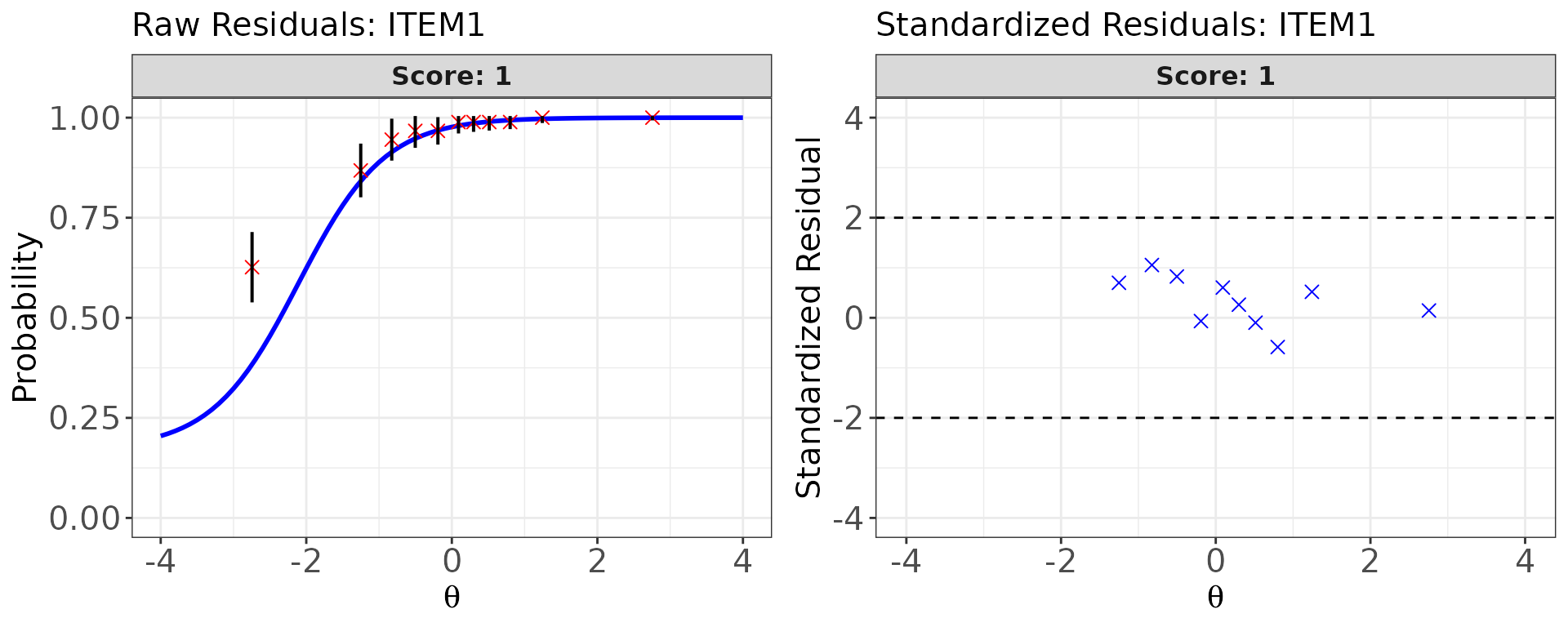
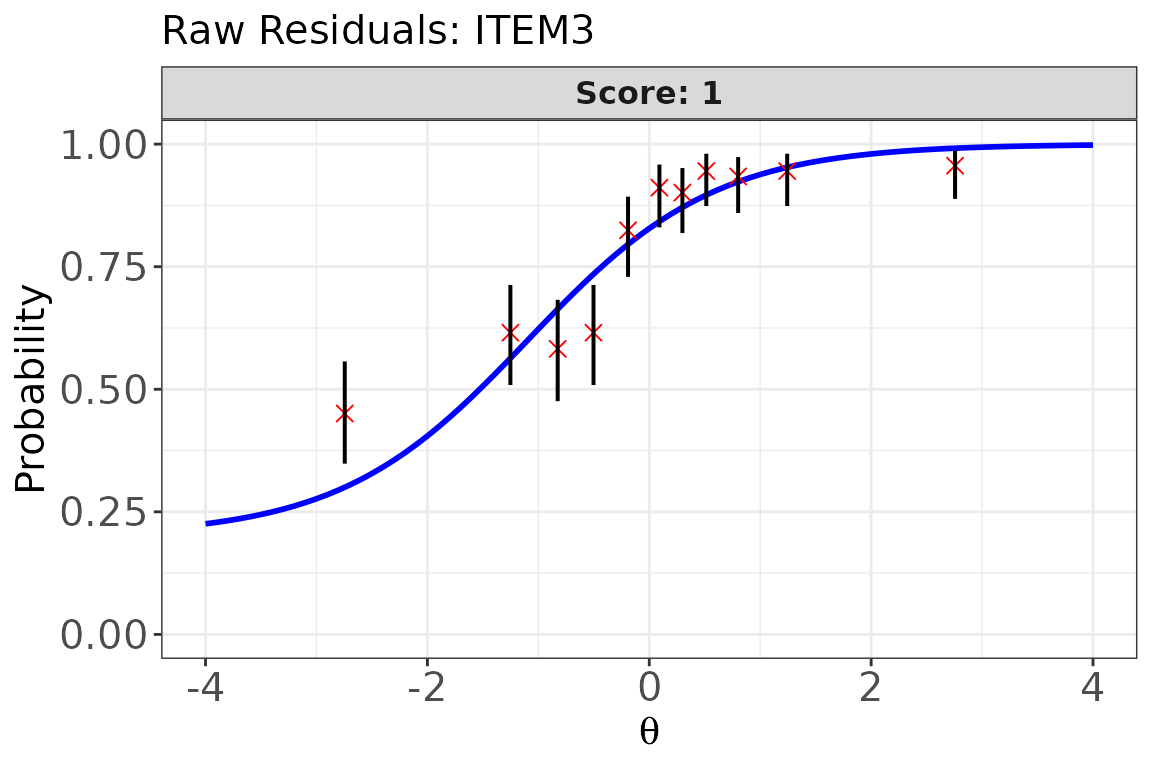
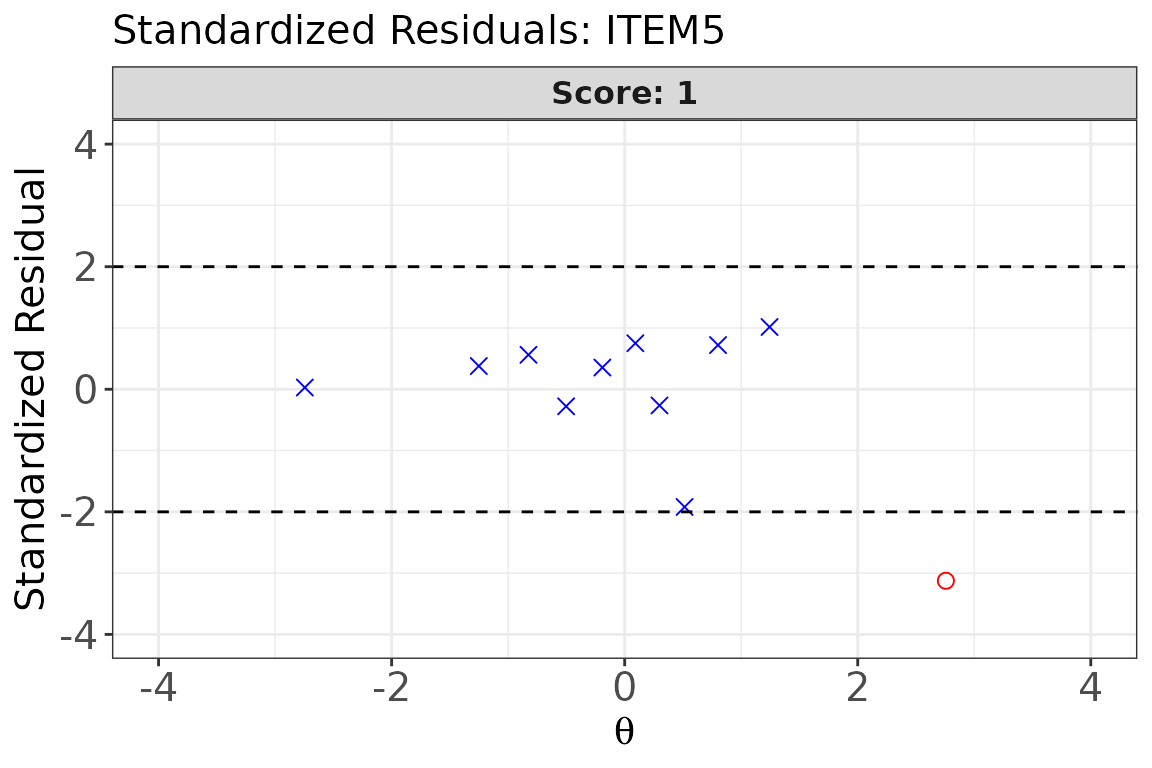
-
type = "icc": Observed proportion correct (with confidence interval) per ability bin overlaid on the model-predicted ICC. Vertical distances are the raw residuals; systematic patterns (e.g., consistent over- or under-prediction across all bins) suggest model misfit. -
type = "sr": Standardized residuals plotted against . Reference lines atoverSRmark the flagging threshold. Points outside these lines identify ability bins where the model fits poorly. -
type = "both": Side-by-side display of both views.
By default the axis of the standardized residual plot spans
to
(ylim.sr). A residual beyond these limits is dropped from
the plot with a warning; set ylim.sr.adjust = TRUE to
extend the axis to the largest residual.
These plots use the uncollapsed contingency tables stored in
fit$contingency.plot, so every original bin is visible even
if adjacent cells were merged during the statistical computation.
# Side-by-side: ICC overlay (raw residuals) + standardized residual plot
plot(
  x          = fit_bin1,
  item.loc   = 1,          # row number in fit_bin1$item_df
  type       = "both",
  ci.method  = "wald",     # confidence interval method for proportion-correct CI
  show.table = FALSE,
  ylim.sr.adjust = TRUE    # extend the residual axis to the largest residual
)
# ICC overlay for Item 3, Wilson score CI (recommended for proportions)
plot(
  x          = fit_bin1,
  item.loc   = 3,
  type       = "icc",
  ci.method  = "wilson",
  show.table = FALSE
)
# Standardized residual plot for Item 5
plot(
  x          = fit_bin1,
  item.loc   = 5,
  type       = "sr",
  show.table = FALSE
)
Confidence interval methods for the
ci.method argument:
| Method | Description |
|---|---|
"wald" |
Normal-approximation (Wald) interval with the model-implied standard error, simplest but can be unreliable for small |
"wilson" |
Wilson score interval, good coverage even for small |
"wilson.cr" |
Wilson interval with continuity correction |
All three methods give two-sided
intervals, where
is the alpha argument of irtfit() (95%
intervals by default).
Part 3: Traditional Fit for Mixed-Format Tests
irtfit() handles mixed-format tests transparently.
Simply provide the mixed-format item metadata and the ability estimates;
the function computes the appropriate statistics for each item according
to its model type.
fit_mix <- irtfit(
  x            = meta_cal_mix,
  score        = score_mix$est.theta,
  data         = resp_mix,
  D            = 1.702,
  group.method = "equal.freq",
  n.width      = 10,
  loc.theta    = "middle",
  range.score  = c(-4, 4),
  alpha        = 0.05,
  overSR       = 2
)

fit_mix$fit_stat
#>       id     X2     G2 df.X2 df.G2 crit.val.X2 crit.val.G2  p.X2  p.G2 outfit
#> 1   DRM1  4.970  7.557     6     9       12.59       16.92 0.548 0.579  0.728
#> 2   DRM2  3.205  3.458     6     9       12.59       16.92 0.783 0.943  0.854
#> 3   DRM3  5.626  5.991     7    10       14.07       18.31 0.584 0.816  0.874
#> 4   DRM4  8.235  8.466     7    10       14.07       18.31 0.312 0.583  0.908
#> 5   DRM5  3.383  3.474     7    10       14.07       18.31 0.847 0.968  0.926
#> 6   DRM6  3.740  3.958     7    10       14.07       18.31 0.809 0.949  0.943
#> 7   DRM7  5.604  5.781     7    10       14.07       18.31 0.587 0.833  0.933
#> 8   DRM8  3.987  4.037     7    10       14.07       18.31 0.781 0.946  0.965
#> 9   DRM9 14.706 15.245     7    10       14.07       18.31 0.040 0.123  0.968
#> 10 DRM10  4.789  7.690     5     8       11.07       15.51 0.442 0.464  0.597
#> 11 DRM11  9.057  9.540     7    10       14.07       18.31 0.249 0.482  0.905
#> 12 DRM12  3.511  3.833     7    10       14.07       18.31 0.834 0.955  0.893
#> 13 DRM13  8.092  9.090     7    10       14.07       18.31 0.325 0.524  0.898
#> 14 DRM14  4.999  4.989     7    10       14.07       18.31 0.660 0.892  0.953
#> 15 DRM15  5.434  5.674     6     9       12.59       16.92 0.489 0.772  0.847
#> 16  GRM1 14.109 18.897    11    15       19.68       25.00 0.227 0.218  0.821
#> 17  GRM2 21.338 27.507    20    24       31.41       36.42 0.377 0.281  0.831
#> 18  GRM3 14.916 15.939    20    24       31.41       36.42 0.781 0.890  0.898
#> 19  GRM4 21.331 25.015    20    24       31.41       36.42 0.378 0.405  0.839
#> 20  GRM5 22.139 24.305    26    30       38.89       43.77 0.681 0.758  0.933
#>    infit    N overSR.prop
#> 1  0.971 1000       0.000
#> 2  0.934 1000       0.000
#> 3  0.960 1000       0.000
#> 4  0.942 1000       0.000
#> 5  0.962 1000       0.000
#> 6  0.949 1000       0.000
#> 7  0.959 1000       0.000
#> 8  0.973 1000       0.000
#> 9  0.973 1000       0.100
#> 10 0.937 1000       0.000
#> 11 0.959 1000       0.000
#> 12 0.950 1000       0.000
#> 13 0.943 1000       0.000
#> 14 0.969 1000       0.000
#> 15 0.933 1000       0.000
#> 16 0.853 1000       0.000
#> 17 0.876 1000       0.025
#> 18 0.920 1000       0.025
#> 19 0.869 1000       0.125
#> 20 0.942 1000       0.000
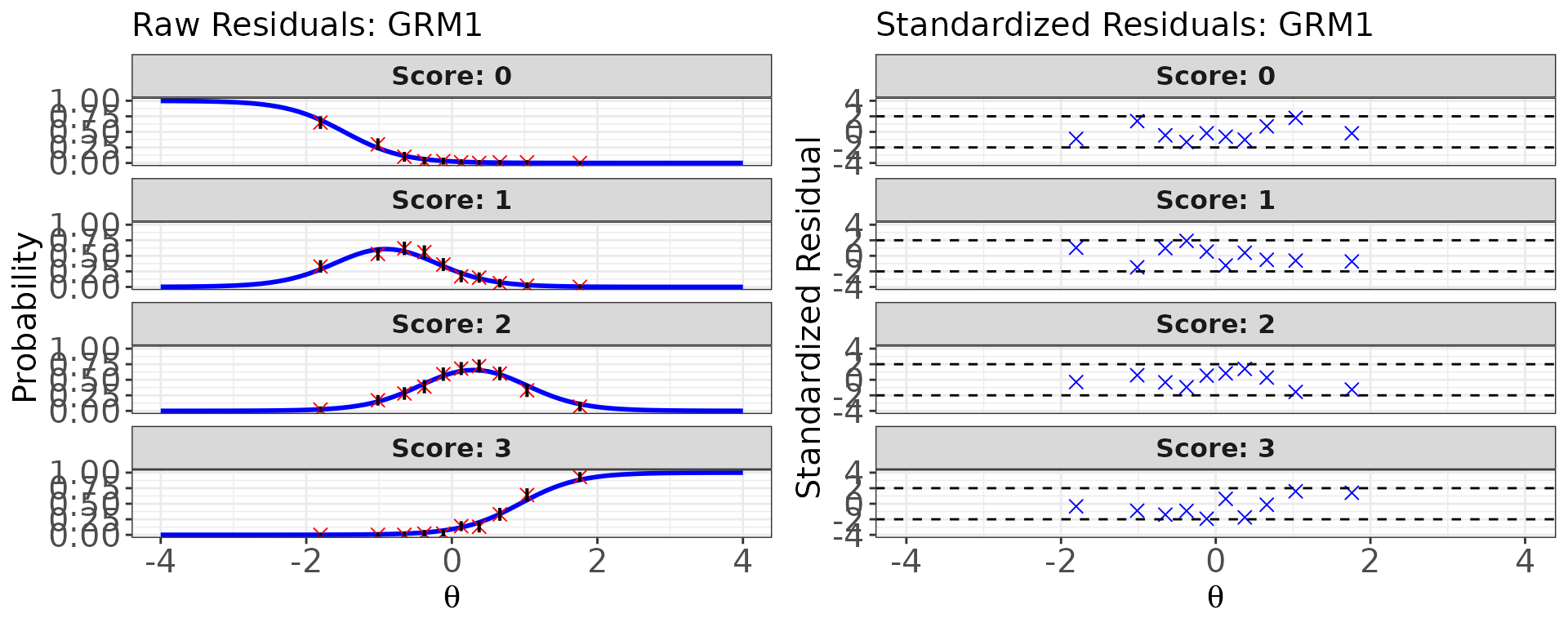
# Residual diagnostics for a GRM item (item 16 in the mixed form)
# For polytomous items, the ICC overlay shows the observed and expected
# *category* proportions rather than a single proportion-correct curve.
plot(
  x          = fit_mix,
  item.loc   = 16,
  type       = "both",
  ci.method  = "wald",
  show.table = FALSE
)
Part 4:
-
Statistic with sx2_fit()
How sx2_fit() Works
The - statistic was proposed by Orlando & Thissen (2000) to address two known weaknesses of the and statistics: (1) the unclear distributional properties of statistics that condition on model-dependent values, and (2) the sample-dependence introduced by arbitrary quantile-based bin boundaries.
Instead of conditioning on , - conditions on the observed summed score . Within each summed-score group , the expected proportion of correct responses is computed using the Lord-Wingersky recursive algorithm (Lord & Wingersky, 1984), which integrates the IRF over the latent ability distribution without requiring individual estimates.
Note. The formula below is presented for dichotomous items (scored 0/1). Kang & Chen (2008) extended - to polytomous items; see the Extension to polytomous items paragraph below.
where is the number of examinees with summed score , is the observed proportion correct on item among those examinees, and is the model-based expected proportion.
Degrees of freedom equal the number of summed-score groups that remain after cell collapsing minus the number of item parameters of the item’s model (parameters fixed in the calibration are also counted). Before any collapsing, the feasible summed-score values exclude 0 and the maximum, where responses to the item are deterministic, so (Ames & Penfield, 2015).
Extension to polytomous items. Kang & Chen (2008) generalized - to polytomous IRT models (GRM, GPCM). The generalization uses the same summed-score conditioning logic but compares observed and expected category frequencies rather than proportion-correct values.
Cell collapsing strategy. When expected cell frequencies are very small, the approximation deteriorates. To address this:
- For dichotomous items: adjacent summed-score groups are
merged until each expected cell frequency
min.collapse(Orlando & Thissen, 2000). - For polytomous items: adjacent response categories within each summed-score group are merged instead, to avoid excessive score-group loss (Kang & Chen, 2008).
Key sx2_fit() Arguments
| Argument | Description |
|---|---|
x |
Item metadata data frame, or an est_irt /
est_item object |
data |
Response matrix (examinees x items). Missing values are replaced with 0 (the lowest category), with a warning. |
D |
Scaling constant; must match calibration |
alpha |
Significance level for flagging items (default
0.05) |
min.collapse |
Minimum expected frequency per cell before collapsing (default
1) |
norm.prior |
c(mean, sd) of the normal latent distribution used in
the Lord-Wingersky integration (default c(0, 1)); ignored
when weights is given |
nquad |
Number of Gaussian quadrature points for integration (default
30) |
weights |
Two-column quadrature points and weights of the latent distribution.
For an est_irt object, when weights,
norm.prior, and nquad are all omitted, the
distribution stored in the object (x$weights) is used |
pcm.loc |
Integer vector of the row indices of PCM items, whose slopes were
fixed in the calibration; used only to count the item parameters for the
df; default NULL
|
Return value of sx2_fit()
sx2_fit() returns a list with the following
components:
| Component | Description |
|---|---|
fit_stat |
Data frame with columns id, chisq
(-
statistic), df, crit.val (critical value at
the specified alpha), and p (p-value); one row
per item |
item_df |
The item metadata used in the analysis |
exp_freq |
List of collapsed expected frequency tables (one per item) |
obs_freq |
List of collapsed observed frequency tables |
exp_prob |
List of collapsed expected probability tables |
obs_prop |
List of collapsed observed proportion tables |
Example 1: Binary test
fit_sx2_bin <- sx2_fit(
  x     = meta_cal_bin,
  data  = resp_bin,
  D     = 1.702,
  alpha = 0.05
)

# Fit statistics for all items
fit_sx2_bin$fit_stat
#>        id  chisq df crit.val     p
#> 1   ITEM1  7.529 10   18.307 0.675
#> 2   ITEM2  9.518  9   16.919 0.391
#> 3   ITEM3 22.945 13   22.362 0.042
#> 4   ITEM4 16.862 11   19.675 0.112
#> 5   ITEM5 16.373 13   22.362 0.230
#> 6   ITEM6 15.613 13   22.362 0.271
#> 7   ITEM7 16.494 13   22.362 0.223
#> 8   ITEM8  9.186 14   23.685 0.819
#> 9   ITEM9 21.144 14   23.685 0.098
#> 10 ITEM10 13.715 14   23.685 0.471
#> 11 ITEM11 12.367 11   19.675 0.337
#> 12 ITEM12  8.828 13   22.362 0.786
#> 13 ITEM13  7.155 13   22.362 0.894
#> 14 ITEM14 21.765 14   23.685 0.084
#> 15 ITEM15 19.839 14   23.685 0.135
#> 16 ITEM16 21.966 11   19.675 0.025
#> 17 ITEM17 17.892 14   23.685 0.212
#> 18 ITEM18 10.636 14   23.685 0.714
#> 19 ITEM19  6.603 10   18.307 0.762
#> 20 ITEM20  9.000 14   23.685 0.831

# Number of items with p < alpha
sum(fit_sx2_bin$fit_stat$p < 0.05)
#> [1] 2
# Inspect collapsed observed vs. expected frequency table for Item 1
# Rows = summed-score bins; columns = item score categories (0 / 1)
cat("--- Expected frequencies (Item 1) ---\n")
#> --- Expected frequencies (Item 1) ---
fit_sx2_bin$exp_freq[[1]]
#>            score.0    score.1
#> score.1   3.039034   1.960966
#> score.3   5.482412   6.517588
#> score.4   9.701771  19.298229
#> score.5   8.122505  25.877495
#> score.6  10.867614  54.132386
#> score.7   5.891911  45.108089
#> score.8   4.917039  57.082961
#> score.9   4.237142  73.762858
#> score.10  2.454973  63.545027
#> score.11  1.983988  76.016012
#> score.12  1.787165 101.212835
#> score.13  1.096256  91.903744
#> score.19  1.286588 311.713412

cat("--- Observed frequencies (Item 1) ---\n")
#> --- Observed frequencies (Item 1) ---
fit_sx2_bin$obs_freq[[1]]
#>          score.0 score.1
#> score.1        2       3
#> score.3        7       5
#> score.4        7      22
#> score.5       11      23
#> score.6       10      55
#> score.7        7      44
#> score.8        2      60
#> score.9        5      73
#> score.10       3      63
#> score.11       2      76
#> score.12       3     100
#> score.13       1      92
#> score.19       1     312
Example 2: Mixed-format test
For polytomous items, the Kang-Chen (2008) extension is applied automatically when GRM or GPCM items are detected.
fit_sx2_mix <- sx2_fit(
  x     = meta_cal_mix,
  data  = resp_mix,
  D     = 1.702,
  alpha = 0.05
)

fit_sx2_mix$fit_stat
#>       id  chisq df crit.val     p
#> 1   DRM1  9.197 18   28.869 0.955
#> 2   DRM2 20.508 19   30.144 0.365
#> 3   DRM3 20.930 23   35.172 0.585
#> 4   DRM4 16.367 23   35.172 0.839
#> 5   DRM5 16.232 24   36.415 0.880
#> 6   DRM6 19.903 24   36.415 0.702
#> 7   DRM7 19.275 23   35.172 0.685
#> 8   DRM8 18.364 25   37.652 0.827
#> 9   DRM9 24.834 25   37.652 0.472
#> 10 DRM10 15.113 16   26.296 0.516
#> 11 DRM11 35.358 23   35.172 0.048
#> 12 DRM12 16.085 24   36.415 0.885
#> 13 DRM13 15.626 24   36.415 0.901
#> 14 DRM14 20.960 25   37.652 0.695
#> 15 DRM15 25.410 21   32.671 0.230
#> 16  GRM1 40.210 44   60.481 0.635
#> 17  GRM2 43.103 52   69.832 0.805
#> 18  GRM3 39.143 53   70.993 0.922
#> 19  GRM4 55.282 51   68.669 0.316
#> 20  GRM5 57.007 56   74.468 0.437
# Inspect observed proportions for GRM item 16 (polytomous)
# Rows = summed-score groups; columns = the cells that remain after category
# collapsing, which match categories 0-3 only in rows without NA
cat("--- Observed proportions for GRM item 1 (item 16) ---\n")
#> --- Observed proportions for GRM item 1 (item 16) ---
fit_sx2_mix$obs_prop[[16]]
#>          score.0   score.1    score.2    score.3
#>  [1,] 0.85185185 0.1481481         NA         NA
#>  [2,] 0.73684211 0.2631579         NA         NA
#>  [3,] 0.47619048 0.5238095         NA         NA
#>  [4,] 0.30769231 0.5641026 0.12820513         NA
#>  [5,] 0.38461538 0.5384615 0.07692308         NA
#>  [6,] 0.37931034 0.4482759 0.17241379         NA
#>  [7,] 0.33333333 0.4444444 0.22222222         NA
#>  [8,] 0.13888889 0.5277778 0.33333333         NA
#>  [9,] 0.07843137 0.7254902 0.19607843         NA
#> [10,] 0.09259259 0.4814815 0.42592593 0.00000000
#> [11,] 0.03030303 0.5757576 0.39393939         NA
#> [12,] 0.02173913 0.4565217 0.50000000 0.02173913
#> [13,] 0.05263158 0.4210526 0.47368421 0.05263158
#> [14,] 0.01851852 0.3148148 0.59259259 0.07407407
#> [15,] 0.22727273 0.6818182 0.09090909         NA
#> [16,] 0.15686275 0.7254902 0.11764706         NA
#> [17,] 0.20000000 0.6200000 0.18000000         NA
#> [18,] 0.16981132 0.6415094 0.18867925         NA
#> [19,] 0.15000000 0.5000000 0.35000000         NA
#> [20,] 0.07142857 0.6190476 0.30952381         NA
#> [21,] 0.02631579 0.6315789 0.34210526         NA
#> [22,] 0.00000000 0.3589744 0.64102564         NA
#> [23,] 0.28125000 0.7187500         NA         NA
#> [24,] 0.23333333 0.7666667         NA         NA
#> [25,] 0.08955224 0.9104478         NA         NA
Interpretation Guide
and
- Under correct model specification, these statistics follow an
approximate
distribution; items with
p.X2 < alphaorp.G2 < alphaare flagged for misfit. - has df = (number of bins left after cell collapsing minus number of item parameters); has df = .
-
Sample-size sensitivity: with large samples, even
trivial deviations from the model produce significant
-values.
With small samples, power is low. Interpret p-values alongside the
overSR.propcolumn (proportion of cells with large standardized residuals) and the residual plots. -
Practical guideline: use
overSR.propas a supplementary indicator. WithoverSR = 2, about 5% of the cells are expected to exceed the threshold when the model holds and the ability estimates were exact. An item with a marginally significant p-value but lowoverSR.propmay not warrant deletion; an item with highoverSR.propconcentrated at a specific ability range signals a meaningful pattern worth investigating. -
Check the grouping first: significant p-values can
result from the grouping choices rather than from model misfit. In
Example 1, the data were generated from the fitted model, yet many items
have p-values below
alpha. Most items have one to three of the 11 bins beyond the threshold (overSR.propbetween 0.09 and 0.27), and these bins are mostly the outer ones, where the wide bins and the midpoint location matter most. Compare the results across grouping options and with - before dropping items.
Infit and Outfit
- Both statistics have an expected value of 1.0 under correct model specification; the interpretation is “mean squared residual relative to expectation.”
- Common decision rules (Ames & Penfield,
2015):
- Values > 1.5 (sometimes > 2.0): underfit, meaning the item is less predictable than the model expects (noise, inconsistent guessing).
- Values < 0.5: overfit, meaning the item is more predictable than the model expects (overly steep ICC, item dependency).
- Infit vs. Outfit: prefer infit for detecting misfit near the item’s difficulty; outfit is more sensitive to extreme-ability aberrant responses (e.g., very able examinees missing an easy item due to carelessness).
- Non-Rasch caution: with 2PLM, 3PLM, GRM, or GPCM items, the expected value and distribution of infit/outfit deviate from 1.0 more than for Rasch items. Treat these statistics as supplementary rather than primary evidence of fit for non-Rasch models.
-
- An item with
p < alphais flagged for misfit (pis the column name infit_stat). - - is generally preferable to and for detecting misfit because it avoids the noise introduced by model-dependent estimates and uses more stable summed-score conditioning (Orlando & Thissen, 2000).
- For very long tests (large
),
the number of summed-score groups grows and expected frequencies per
group can become small; check the collapsed frequency tables
(
exp_freq) to confirm adequate cell sizes.