
Computes routing cut scores for a multistage test (MST) by identifying the
theta values at which adjacent modules' Test Information Functions (TIFs)
cross in the correct direction. The resulting cut scores can be passed
directly to run_mst as its cut_score argument
(with route_method = NULL), which avoids the path reversals that
maximum Fisher information (MFI) routing can produce (see Details).
Arguments
- x
A data frame of item metadata in the standard irtQ format (columns:
id,cats,model,par.1,par.2, ...). Seeshape_dffor details.- module
A binary integer matrix of dimensions J \(\times\) M, where J is the number of items and M is the number of modules. A value of 1 at row j, column m indicates that item j belongs to module m. This is the same
moduleargument used inrun_mst.- route_map
A binary square matrix of dimensions M \(\times\) M defining the MST transition structure. A value of 1 at row i, column j indicates that examinees can be routed from module i to module j. This is the same
route_mapargument used inrun_mst.- D
A scaling constant used in IRT models to make the logistic function closely approximate the normal ogive function. A value of 1.702 is commonly used for this purpose. Default is 1.
- theta_range
A numeric vector of length 2 specifying the theta range over which to search for TIF crossings. Default is
c(-6, 6).- n_grid
An integer specifying the number of equally spaced theta points used for the initial sign-change scan. A finer grid reduces the chance of missing a crossing but increases computation time. It must be at least 100. Default is
2001.- ref_theta
A single numeric value used to break ties when multiple proper crossings are found for an adjacent module pair. The crossing closest to
ref_thetais selected. Default is0.- digits
The number of decimal places used for the mean item locations, the cut scores, and the crossing points. Default is 4. The selected cut score of each module pair is always printed with four decimal places.
- ...
Additional arguments, currently not used.
Value
An object of class "find_cut", which is a named list with
three elements:
cut_scoreA list of length S - 1 (where S is the number of stages), compatible with the
cut_scoreargument ofrun_mst. Each element is a numeric vector of cut scores for the transition into that stage, sorted in ascending order. The elements are named"stage.2","stage.3", etc., after the stage being entered. Stages with only one module have an empty numeric vector (numeric(0)).detailsA list with one element per stage from stage 2 (named
"stage.2","stage.3", etc.). Each element containsmodules(module indices),mean_locs(mean item locations, named"mod2", ...),sorted_order(modules in ascending order of mean location), andpairs, a list with one element per adjacent pair (named, e.g.,"mod2_vs_mod3") holdingleft_module,right_module,proper_crossings,anomalous_crossings, andselected_cut. For a stage with a single module,modulesholds that module,mean_locs,sorted_order, andpairsareNULL, and amessageis added.tif_dataA
tibblewith columnstheta,module,stage, andtif, providing TIF curves for all modules at all stages (including stage 1). Used byplot.find_cutto visualize TIF curves and crossing points.
Details
Motivation: the MFI routing problem
When run_mst uses Maximum Fisher Information (MFI) routing
(route_method = "mfi"), it selects the next-stage module that
maximizes TIF at the examinee's current ability estimate. In principle, a
harder module should always have a higher TIF for high-ability examinees,
and a lower TIF for low-ability examinees, making MFI routing work as
intended. However, in practice, a harder module's TIF curve can peak at
a theta value that is unexpectedly low, so that the harder module
also has the highest TIF near the low end of the ability scale.
In this case, a low-ability examinee is incorrectly routed into the harder
module, which is the opposite of what the MST is designed to do. This is
called an anomalous routing or path reversal.
Solution: TIF-crossing cut scores
find_cut() resolves this problem by computing cut scores from the
TIF curves themselves, rather than relying on pure MFI at the time of
routing. Specifically, for each pair of modules that are adjacent in module
index (which should follow the order of difficulty; see Module index
vs. difficulty order), the function finds the theta value at which the
higher-index module's TIF first overtakes the lower-index module's TIF
from below as theta increases. This crossing point is the natural
boundary between the two modules: below it, the lower-index (easier) module
is more informative; above it, the higher-index (harder) module is more
informative. Using this point as a fixed cut score pre-empts the path
reversals that MFI routing produces at the extremes of the scale.
Proper vs. anomalous crossings
Two TIF curves may cross more than once. find_cut() distinguishes
two types of crossing:
Proper crossing: the difference \(\text{TIF}_{\text{right}}(\theta) - \text{TIF}_{\text{left}}(\theta)\), where the right module is the higher-index (intended harder) module of the pair, changes sign from negative to positive (positive slope at the crossing). This is the correct, expected crossing in the middle of the theta scale.
Anomalous crossing: the difference changes sign from positive to negative (negative slope at the crossing). This corresponds to the pathological situation in which the harder module temporarily dominates at the low end of the theta scale, which is the pattern that causes path reversals under MFI routing.
Only proper crossings are used as cut scores. Anomalous crossings are
reported in $details for diagnostic purposes but excluded from the
returned cut_score. If no proper crossing is found for a module pair,
an informative error is thrown. If multiple proper crossings are found
(unusual for well-designed modules), a warning is issued and the one
closest to ref_theta is selected.
Algorithm
The function proceeds stage by stage (from stage 2 onward). At each stage:
For each adjacent pair of modules in the order supplied by the user (ascending module index), the difference \(\text{TIF}_{\text{right}}(\theta) - \text{TIF}_{\text{left}}(\theta)\) is evaluated on a fine theta grid of
n_gridpoints, where "left" and "right" refer to the lower- and higher-index module in the pair. Sign changes on the grid are detected and then refined withuniroot.The slope at each refined root is estimated by a finite difference (step size 0.01) to classify it as proper or anomalous.
The selected proper crossing is stored as the cut score for that pair.
Module index vs. difficulty order
run_mst internally orders candidate modules by ascending
module index and maps routing rank 1 to the lowest-index module. For
cut-score routing to assign low-theta examinees to the easiest module, the
modules at each stage must be numbered in ascending difficulty order
(easiest module = lowest index). find_cut() checks this assumption
and issues a warning if the difficulty order does not match the index order.
Regardless of this warning, cut scores are always computed between
consecutive module pairs in the supplied index order (e.g., modules 2 & 3
and 3 & 4, not 2 & 4 and 4 & 3). The cut scores of each stage are returned
in ascending order. When the index order and the difficulty order agree, the
k-th cut score is the crossing between the k-th and the
(k+1)-th module of the stage, which is how run_mst and
reval_mst use it.
Methods (by generic)
print(find_cut): Print method for an object of classfind_cut(given asx). It prints, for each stage, the mean item locations of the modules, the proper and anomalous crossing points, and the selected cut score of each pair of adjacent modules.
Examples
## Setup: use the built-in simMST 1-3-3 panel
## simMST is a 7-module, 3-stage MST panel (8 dichotomous 3PLM items each).
## Modules 1 (routing), 2-4 (stage 2: easy/medium/hard),
## 5-7 (stage 3: easy/medium/hard).
x <- simMST$item_bank
module <- simMST$module
route_map <- simMST$route_map
## Find TIF-crossing cut scores
## For each adjacent module pair at stages 2 and 3, find_cut() identifies
## the theta at which the harder module's TIF first exceeds the easier
## module's TIF (proper crossing), and returns it as a cut score.
cut_result <- find_cut(x = x, module = module, route_map = route_map, D = 1.702)
## Print a summary: crossing points found, anomalous crossings excluded,
## and the final selected cut scores per stage transition.
print(cut_result)
#> MST TIF-Crossing Cut Score Results
#> ==================================================
#>
#> stage.2
#> -----------------------------------
#> Modules (index order) : 2, 3, 4
#> Modules (difficulty order): 2, 3, 4
#> Mean item locations : -0.87, -0.0574, 0.7858
#> Selected cut score(s) : -0.4451, 0.4589
#> Pair details:
#> [mod2_vs_mod3]
#> Proper crossing(s) : 1 [theta = -0.4451]
#> Anomalous crossing(s) : 1 [theta = 3.3893] (excluded)
#> Selected cut score : -0.4451
#> [mod3_vs_mod4]
#> Proper crossing(s) : 1 [theta = 0.4589]
#> Selected cut score : 0.4589
#>
#> stage.3
#> -----------------------------------
#> Modules (index order) : 5, 6, 7
#> Modules (difficulty order): 5, 6, 7
#> Mean item locations : -0.5586, -0.042, 0.5066
#> Selected cut score(s) : -0.4171, 0.4532
#> Pair details:
#> [mod5_vs_mod6]
#> Proper crossing(s) : 1 [theta = -0.4171]
#> Anomalous crossing(s) : 1 [theta = 1.617] (excluded)
#> Selected cut score : -0.4171
#> [mod6_vs_mod7]
#> Proper crossing(s) : 1 [theta = 0.4532]
#> Anomalous crossing(s) : 1 [theta = -1.9874] (excluded)
#> Selected cut score : 0.4532
#> ==================================================
#> Usage: run_mst(..., route_method = NULL, cut_score = <result>$cut_score)
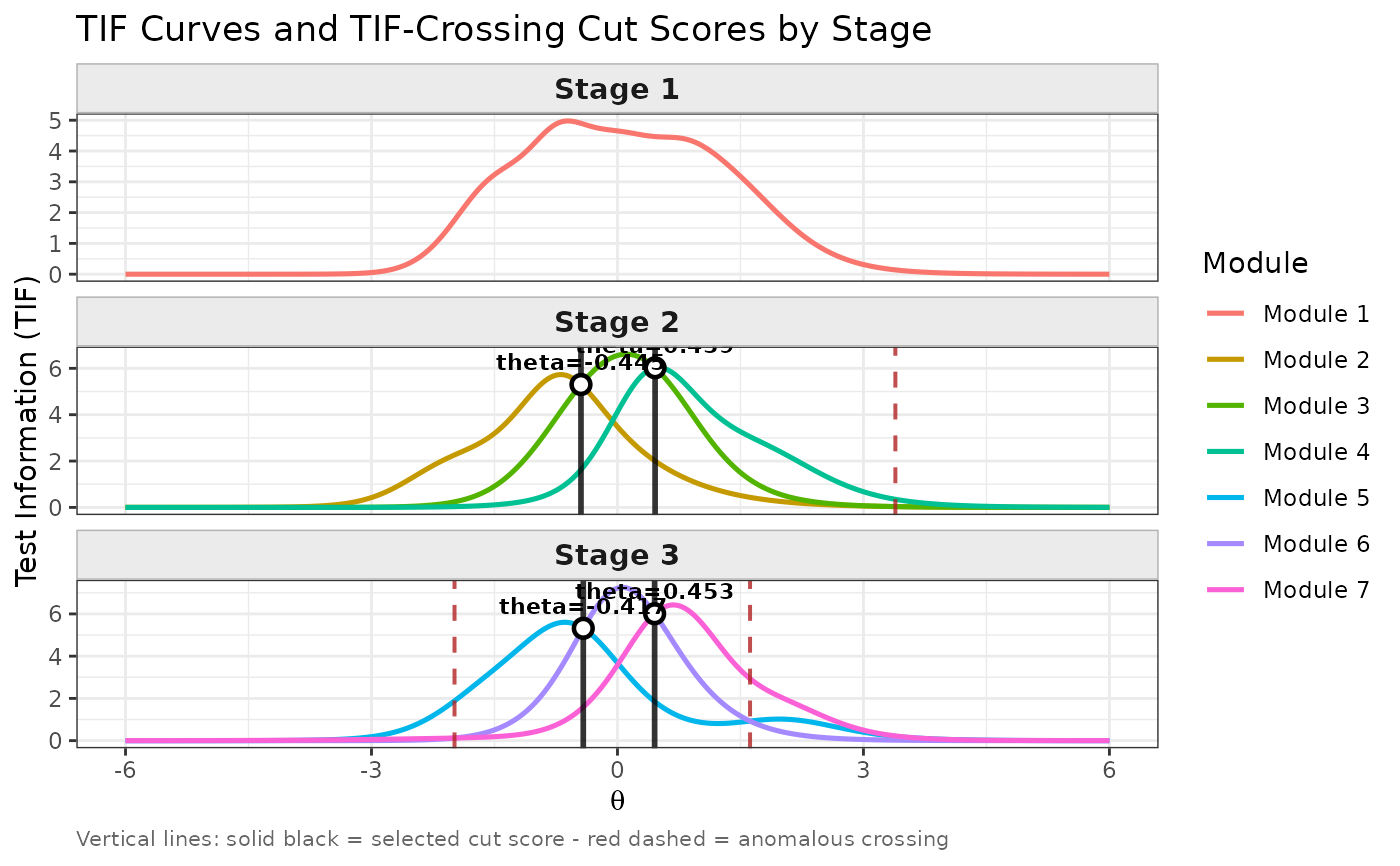
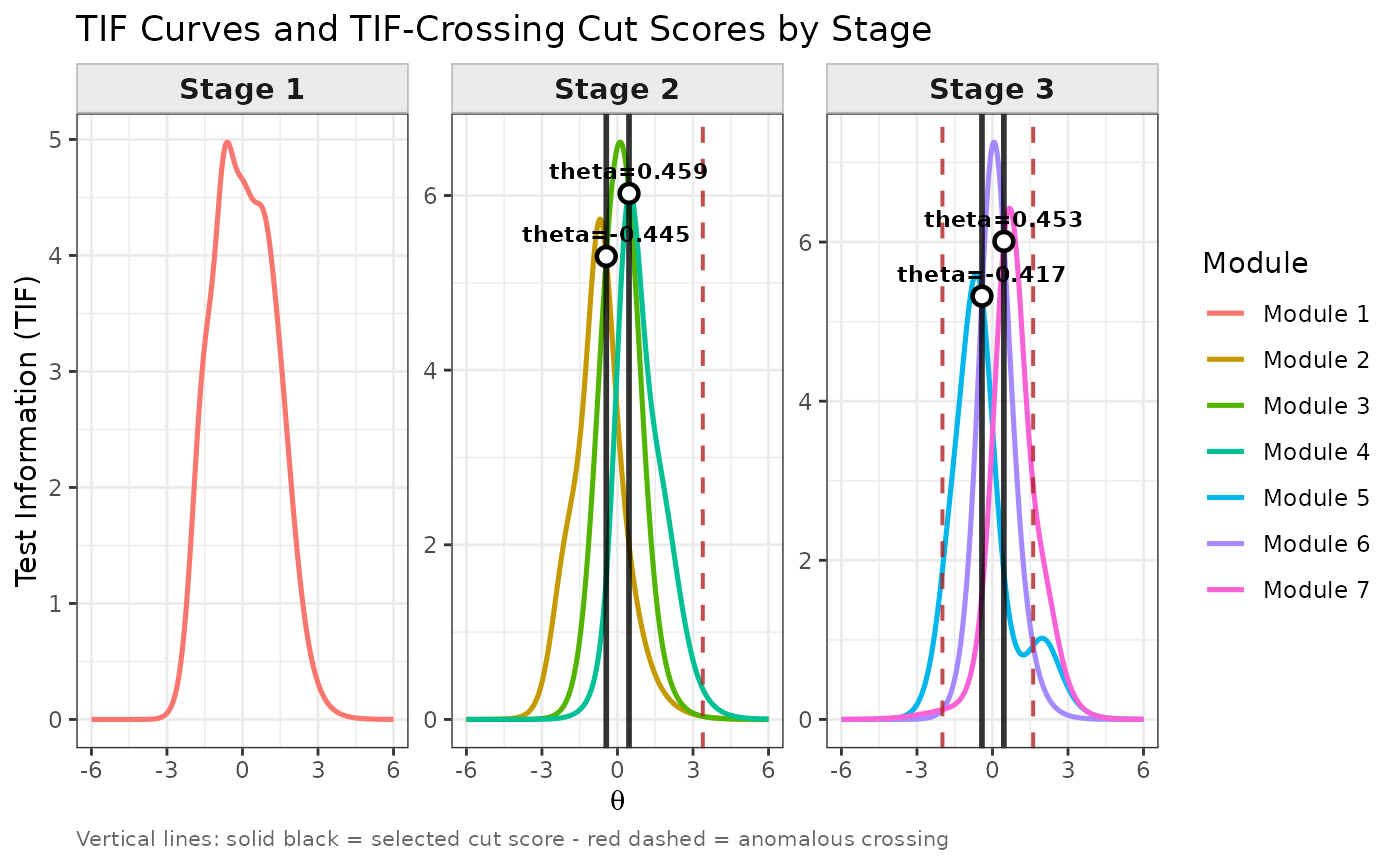
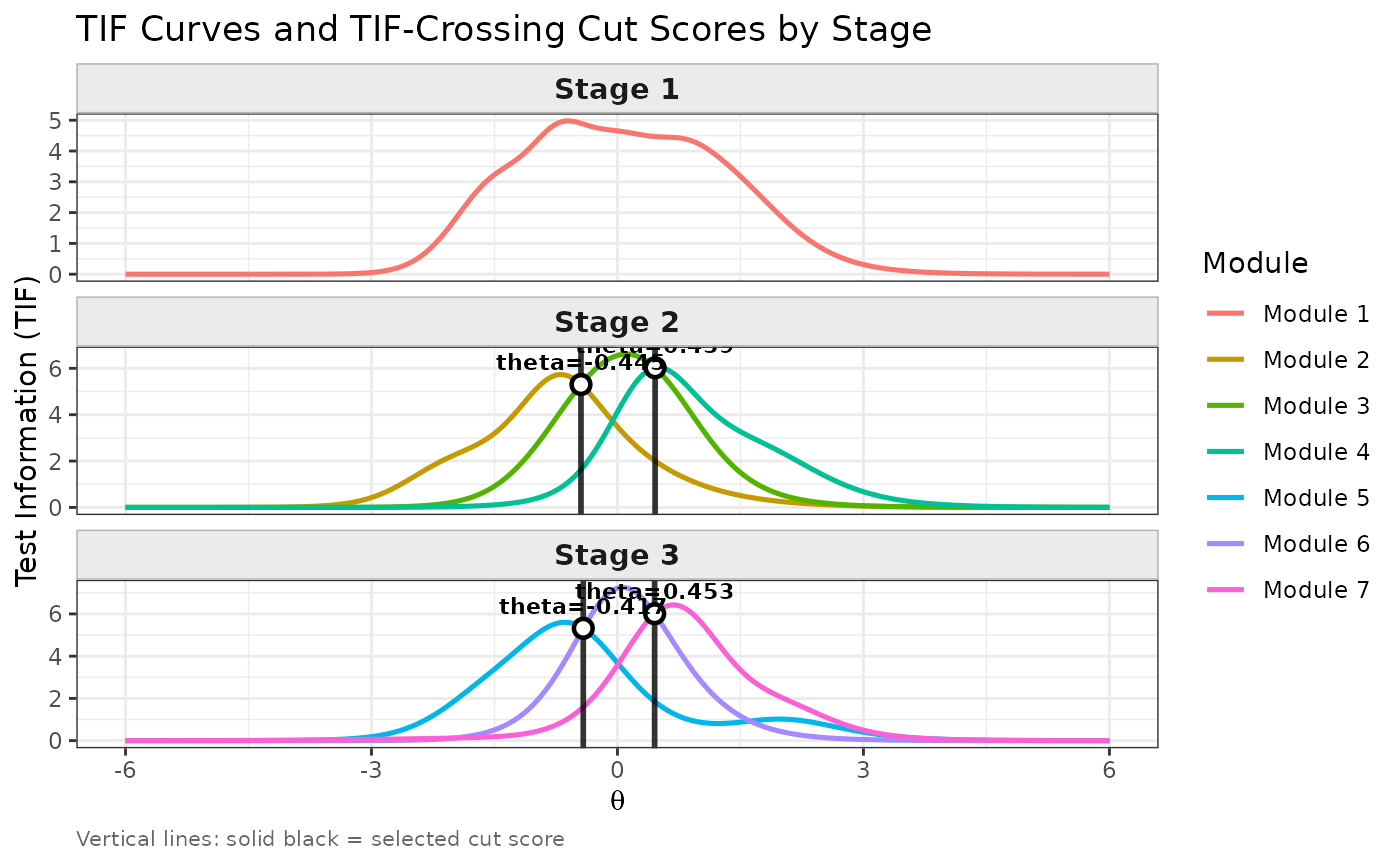
## Visualize TIF curves and cut scores
## plot() shows TIF curves for every module faceted by stage.
## Selected cut scores appear as solid black vertical lines with theta
## labels at the crossing point. Anomalous crossings (if any) appear
## as dashed red lines.
plot(cut_result) # stages stacked vertically (default)
 plot(cut_result, layout = "horizontal") # stages side by side
 plot(cut_result, show_anomalous = FALSE) # hide anomalous crossing markers
 ## Inspect the cut_score element, a list that can be passed to run_mst()
## cut_score[[1]]: two cut scores for the stage-1 -> stage-2 transition
## cut_score[[2]]: cut scores for the stage-2 -> stage-3 transition
cut_result$cut_score
#> $stage.2
#> [1] -0.4450901 0.4588774
#>
#> $stage.3
#> [1] -0.4170988 0.4531584
#>
## Compare with the cut scores stored in simMST, which were obtained the
## same way; the two sets agree up to numerical precision
simMST$cut_score
#> $stage.2
#> [1] -0.4450901 0.4588774
#>
#> $stage.3
#> [1] -0.4170988 0.4531584
#>
all.equal(cut_result$cut_score, simMST$cut_score)
#> [1] TRUE
## Use the cut scores in run_mst()
## Pass cut_result$cut_score directly to run_mst() with route_method = NULL.
## This replaces pure MFI routing with TIF-crossing-based fixed cut scores,
## preventing anomalous path reversals at the extremes of the theta scale.
# \donttest{
set.seed(1)
theta_true <- rnorm(500)
result <- run_mst(
x = x,
route_map = route_map,
module = module,
theta = theta_true,
D = 1.702,
route_method = NULL,
cut_score = cut_result$cut_score,
verbose = FALSE
)
# }
## Inspect the cut_score element, a list that can be passed to run_mst()
## cut_score[[1]]: two cut scores for the stage-1 -> stage-2 transition
## cut_score[[2]]: cut scores for the stage-2 -> stage-3 transition
cut_result$cut_score
#> $stage.2
#> [1] -0.4450901 0.4588774
#>
#> $stage.3
#> [1] -0.4170988 0.4531584
#>
## Compare with the cut scores stored in simMST, which were obtained the
## same way; the two sets agree up to numerical precision
simMST$cut_score
#> $stage.2
#> [1] -0.4450901 0.4588774
#>
#> $stage.3
#> [1] -0.4170988 0.4531584
#>
all.equal(cut_result$cut_score, simMST$cut_score)
#> [1] TRUE
## Use the cut scores in run_mst()
## Pass cut_result$cut_score directly to run_mst() with route_method = NULL.
## This replaces pure MFI routing with TIF-crossing-based fixed cut scores,
## preventing anomalous path reversals at the extremes of the theta scale.
# \donttest{
set.seed(1)
theta_true <- rnorm(500)
result <- run_mst(
x = x,
route_map = route_map,
module = module,
theta = theta_true,
D = 1.702,
route_method = NULL,
cut_score = cut_result$cut_score,
verbose = FALSE
)
# }